

Record-breaking black hole collision detected by astronomers.

Astronomers have recorded the largest black hole merger ever observed — a cosmic collision between two giants, each outweighing more than a hundred suns. The event, designated GW231123, was detected by the Laser Interferometer Gravitational-Wave Observatory (LIGO), whose twin facilities in Livingston, Louisiana, and Hanford, Washington, captured faint distortions in space-time caused by the violent crash. These ripples are known as gravitational waves.
Albert Einstein first predicted gravitational waves in 1915 as part of his theory of relativity, though he doubted they would ever be measurable by human instruments. That changed in 2016, when LIGO achieved its groundbreaking first detection during a black hole collision, confirming Einstein’s vision. A year later, three scientists were honored for their pivotal role in developing what many now call a “black hole telescope.”
Since then, LIGO and its partner observatories — Virgo in Italy and KAGRA in Japan — have identified roughly 300 black hole mergers. “These detectors are the most sensitive instruments humanity has ever built,” explained Mark Hannam, director of the Gravity Exploration Institute at Cardiff University and member of the LIGO Scientific Collaboration. “They allow us to witness the universe’s most extreme and violent events through the tiniest of measurements.”
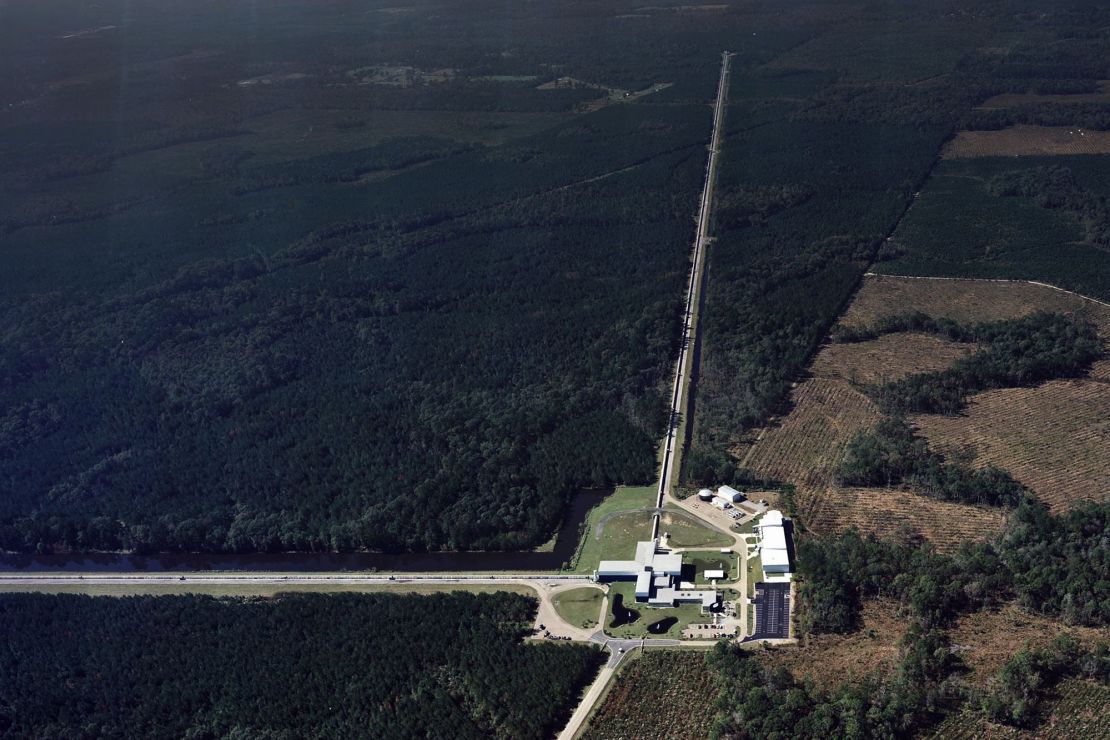
Astronomers have documented the most massive black hole merger ever detected — a titanic clash between two giants, each exceeding the mass of a hundred suns. The phenomenon, labeled GW231123, was captured by the Laser Interferometer Gravitational-Wave Observatory (LIGO). Its twin facilities in Livingston, Louisiana, and Hanford, Washington, registered subtle distortions in space-time created by the cataclysmic impact. These distortions are known as gravitational waves.
Gravitational waves were first predicted in 1915 by Albert Einstein as part of his theory of relativity, though he believed they would remain forever beyond the reach of human technology. That assumption was overturned in 2016, when LIGO made its historic first detection during a black hole collision, once again validating Einstein’s ideas. The following year, three scientists were awarded for their groundbreaking contributions to what is often referred to as a “black hole telescope.”
Since that milestone, LIGO — together with its sister observatories Virgo in Italy and KAGRA in Japan — has recorded evidence of nearly 300 black hole mergers. “These detectors are the most sensitive instruments ever built by humanity,” noted Mark Hannam, director of the Gravity Exploration Institute at Cardiff University and member of the LIGO Scientific Collaboration. “They enable us to observe the universe’s most extreme and violent events through the tiniest of measurements.”
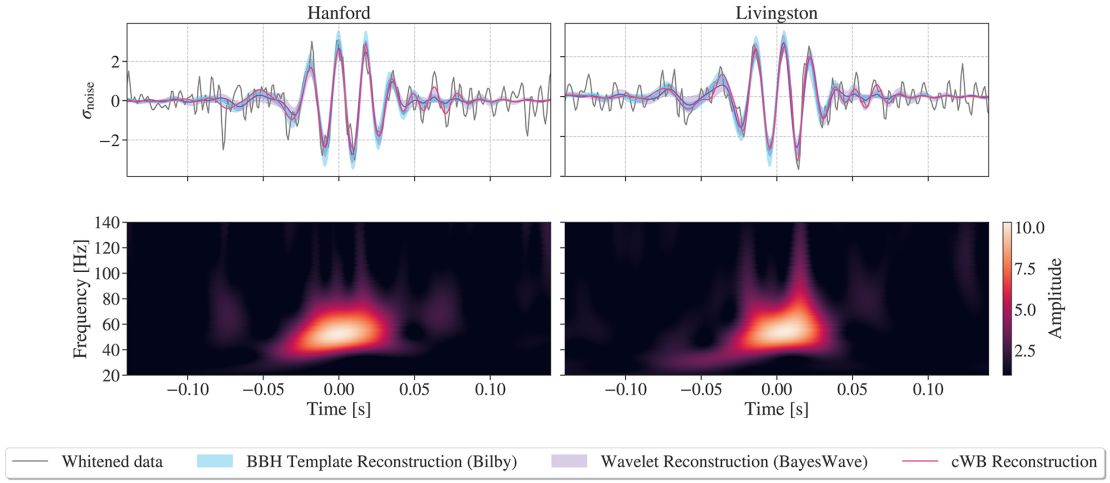
GW231123, as observed by the two LIGO detectors. — LIGO-Virgo-KAGRA Collaboration
Scientists believe GW231123 may be the result of a chain reaction of black hole mergers. “You can imagine a process where increasingly massive black holes are built up through successive collisions,” explained Mark Hannam. “The masses we see in GW231123 are difficult to account for through standard formation mechanisms, which strongly suggests this alternative pathway of repeated mergers.”
If confirmed, this would point to a previously unknown class of black holes — ones that bridge the gap between stellar-mass black holes formed from collapsing stars and the supermassive black holes anchoring galaxies, said Dan Wilkins of Stanford University’s Kavli Institute for Particle Astrophysics and Cosmology, who was not involved in the discovery.
“Gravitational waves are opening an entirely new window into black holes and revealing mysteries we couldn’t access before,” Wilkins added. “Until gravitational wave astronomy, we could only detect black holes actively feeding on matter, producing bright emissions. Now, we’re uncovering a hidden population that grows by merging with other black holes instead.”
Spinning at extreme speeds
Another striking feature of GW231123 is the rapid spin of the two black holes.
“Most black holes detected through gravitational waves have been relatively slow-spinning,” noted Charlie Hoy. “GW231123 suggests either a different formation mechanism or that our current models need revision.”
Such high rotational speeds are difficult to explain, but they align with the idea of prior mergers, since black holes formed from earlier collisions are expected to spin faster, Hannam said.
“GW231123 pushes the limits of our models,” added Sophie Bini of Caltech and the LIGO-Virgo-KAGRA Collaboration. “Fast spins are complex to model, making this event extraordinary and challenging to interpret. What surprised me most is how much we still have to learn. I hope future detections of similar events will deepen our understanding.”
Breaking records
The previous record-holder, GW190521, was only about 60% as massive as GW231123. Hannam noted that even larger mergers may be discovered in the future, especially with next-generation observatories such as the proposed Cosmic Explorer in the US and the Einstein Telescope in Europe.
“This discovery opens a new chapter in understanding how black holes form and grow,” said Imre Bartos of the University of Florida, who was not part of the research. “It also highlights how quickly gravitational wave astronomy has advanced — in less than a decade we’ve gone from the first detection to probing events that challenge our best theories.”
Competing explanations
While repeated mergers remain the most natural explanation for GW231123’s high mass and rapid spin, other scenarios have been proposed — including multiple collisions in dense star clusters or the direct collapse of an unusually massive star. However, Bartos noted that these alternatives are less likely to produce such fast-spinning black holes.
Zoltan Haiman of the Institute of Science and Technology Austria agreed: “The idea of successive mergers was raised right after LIGO’s first detection, but GW231123 is especially difficult to explain otherwise.”
Future observations, he added, will reveal “whether this heavyweight collision was a rare one-off or the first glimpse of a much larger population.”

